Single elimination, from draw to champion

Tournament BracketGenerator

Draw first-round matchups, protect top seeds, and advance winners with confirmed scores. Automatic byes keep non-power-of-two rosters usable.

Free • Local processing • No account

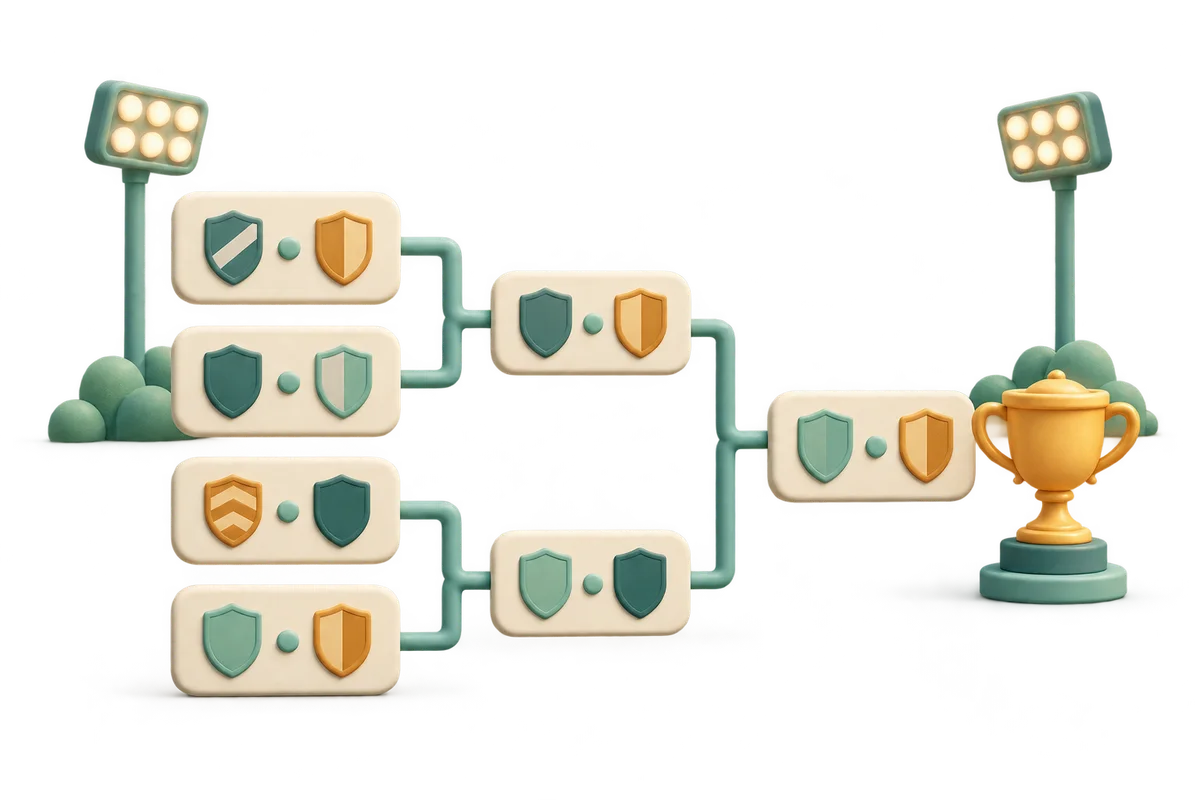
Clay tournament match plaques narrowing from four opening matches to a final trophy along teal bracket rails

Draw and run a single elimination tournament

Enter players or teams, choose a seeding rule, then confirm each completed match.

Tournament entrants

One entrant per line. 2–64 entrants, 120 characters per name, 10,000 input characters. Duplicate names keep separate IDs.

UTF-8 TXT up to 40,000 bytes within text limits. Roster changes clear the draw and all scores.

Protected seeds are the first 2 or 4 roster entries in that order. Two seeds occupy opposite halves; four occupy separate quarters. Others are shuffled. Higher seeds get available byes first.

Single elimination only. Byes advance automatically. A waiting entrant must still face the winner of an unresolved branch.

6
Entrants
—
First-round byes
—
Played / needed
Six entrants are ready for a random single elimination draw.

Match scores and advancement

Generate a draw to see first-round byes, match paths and score entry.

Draws and scores stay in this tab without uploads or persistent tool storage. Export before refreshing. No live sharing or project reimport.

From the first draw to the final result

The draw fixes the path; confirmed match scores determine who travels along it.

One loss ends the run

A tournament bracket generator arranges entrants into a knockout tree. Each played match eliminates one entrant, and its winner advances to the next linked match. This page supports single elimination only, with two to sixty-four players or teams represented as individual roster entries. It is useful for a club competition, classroom game or small community event when you need a clear route to one champion. It does not rank every eliminated entrant, create a consolation competition or schedule venues and start times.

An organizer records a result beside two players competing in a bright community table-tennis hall

Byes fill the tree without inventing opponents

A full bracket has two, four, eight, sixteen, thirty-two or sixty-four slots. When the roster does not fill that size, the remaining slots become first-round byes. A bye advances the real entrant automatically and does not count as a played match. Seeds have a different purpose: the first two or four roster entries can receive protected positions so the strongest declared seeds are separated. Other entries are shuffled. The tool does not infer ability from names or guarantee that the best player wins.

An overhead draw tray with crowned seed shields in opposite halves beside empty mint recesses and other team markers

How to make a random tournament bracket

Settle the roster and seeding policy before playing any match.

  1. 01

    Enter the players or teams

    Paste one entrant per line or import a UTF-8 TXT file. Blank lines are ignored. Matching names remain separate numeric IDs, so add a team suffix or another clear label if needed. The limits are two to sixty-four entrants, one hundred twenty characters per name, ten thousand input characters and forty thousand bytes per imported file. Each entry competes as one unit; the page does not build teams from individual players. Roster edits invalidate the old draw and all its scores immediately.

  2. 02

    Choose a random draw or protect named seeds

    Random mode shuffles every entrant before placing the draw. Protect top two treats the first two roster lines as seeds one and two and places them in opposite halves. Protect top four treats the first four lines as seeds one through four and puts them in different quarters; at least four entrants are required. All remaining entries are shuffled, not treated as ranked seeds. When byes are available, higher declared seeds receive priority. Inspect the opening round before accepting or printing the draw.

  3. 03

    Confirm scores and follow the linked rounds

    Select a round to enter scores for matches whose two participants are known. Type whole numbers from zero to nine thousand nine hundred ninety-nine and confirm the match; merely editing a score field changes only its draft. Higher score wins, and equal scores are rejected. A bye needs no score. Later matches stay pending until both incoming branches have resolved, even if one participant is already waiting. Select the next round to continue, and the champion appears only after the final has been decided.

A usable knockout bracket, including corrections

Make the progression rules visible before the event begins.

Automatic first-round byes with real match counts

The bracket size is the smallest power of two that can hold the roster. Subtract the roster size from that bracket size to find the number of first-round byes. The rounds follow the bracket size, while a completed tournament with n entrants needs n minus one actual matches. Those numbers answer different planning questions. The page shows byes and confirmed matches separately, and exports include the structural bye nodes with explicit status. It does not insert later-round byes or count an automatic advance as a sporting result.

Seed protection that changes actual positions

The single elimination bracket maker uses a folded seed order to place declared seeds. For eight slots that order is one, eight, four, five, two, seven, three, six. With the first two seeds protected, they cannot meet before the final if both keep winning. With four protected seeds, they occupy separate quarters and cannot meet in the opening quarter paths before the semifinals. Undeclared entries remain random. Randomness uses the browser’s secure random source, but constrained draws are not a promise of uniform sampling across every conceivable bracket layout.

Corrections clear the affected advancement path

An organizer can replace a confirmed score. If the winner stays the same, downstream results remain valid and are retained. If the winner changes, every later score on that match’s route to the final is cleared, because its participants may have changed. Other branches keep their confirmed results. Clearing one match result has the same dependency rule. Clear all scores preserves the opening draw and byes; Generate another bracket creates a new draw and discards every score. These actions are intentionally different so a score correction does not accidentally reshuffle the event.

Example: six teams in an eight-slot bracket

Three rounds, two byes and five played matches.

  1. 01

    Separate the draw structure from games to play

    Enter Falcons, Otters, Pines, Comets, Waves and Sparks, then protect the top two seeds. The bracket expands to eight slots and gives Falcons and Otters the two first-round byes in opposite halves. Four other teams play two first-round matches. Their winners meet the waiting seeds in two semifinals, and the semifinal winners meet in the final. The displayed tree contains seven match nodes, including two bye nodes, but only five games must be played to produce a champion.

  2. 02

    Work through a result and a correction

    Suppose Comets beat Waves seven to four and move into a semifinal against Falcons. Confirming that semifinal can place its winner in the final once the opposite half has also resolved. If the first score was entered backward and Waves actually won, changing it clears that semifinal’s stored result and any stored final result. The opposite semifinal remains untouched. This avoids leaving a score attached to a team that no longer belongs in that match; drafts along the affected path are cleared as well.

Prepare the event and keep a complete copy

The local bracket handles progression; the organizer still runs the competition.

  1. 01

    Announce the rules for seeds, ties and withdrawals

    Choose seed identities and their roster order before drawing. Decide how the sport resolves ties and enter the final decisive score in this tool; a tied score cannot choose a winner. The page does not implement sets, penalties, aggregate legs, forfeits or automatic withdrawal rules. It also does not allocate courts, calculate rest intervals or enforce sport-specific score ranges. If an entrant withdraws, determine the event’s policy outside the tool. Editing the roster creates a new event draw rather than patching an in-progress bracket.

  2. 02

    Copy, export or print every round

    Copy includes all rounds, source match references, known participants, confirmed scores, bye status and the champion state. CSV includes every structural node, entrant IDs, actual seed labels and winner details, even when the selected on-screen round shows only part of the event. Formula-leading names are protected for spreadsheet use. Print produces round-by-round tables with repeated column headers and wrapping names instead of squeezing a sixty-four-slot tree onto one tiny sheet. Pending matches retain their source IDs so a paper bracket can be followed before all opponents are known.

  3. 03

    Keep the right tool for the job

    All draw and score state lives in this browser tab without persistent tool storage or uploads. Export before refreshing or leaving; CSV and copied text are organizer records, not an importable project backup or a live shared link. This random matchup generator follows one knockout path to a champion. For a single round of partners without progression, use Random Pair Generator. For assigning people into teams before the tournament, use the group generator, then enter the completed team names here.

Tournament bracket questions

Answers about six-team draws, seeds, scores and printing.

How do I generate a random single elimination bracket?

Enter two to sixty-four player or team names, leave the draw mode random, and generate. The roster is shuffled into a fixed knockout tree. First-round byes fill unused slots. Confirm unequal whole-number scores as games finish to advance winners through the linked rounds.

How does a six-team tournament bracket work?

Six entrants use an eight-slot tree with two first-round byes. Four entrants play two opening games, followed by two semifinals and one final: three rounds and five played games in total. Protecting the top two seeds gives those seeds the two byes in opposite halves.

Do I need a power-of-two number of teams?

No. Any roster from two through sixty-four entries is supported, including odd sizes. The tool uses the next power of two and creates the required first-round byes. Byes advance automatically and are excluded from the count of played matches.

How are seeds placed, and who gets a bye?

Protect top two uses the first two roster entries as seeds in opposite halves. Protect top four uses the first four entries in separate quarters. Other entries are shuffled. Available byes go to higher declared seeds first; any remaining byes go to randomly placed unseeded entrants. Seed protection does not evaluate ability.

Do winners advance automatically when I enter scores?

A winner advances after you confirm that match’s score, not while typing. Both opponents must be known, scores must be whole numbers from zero to 9,999, and ties are rejected. The higher score wins. A waiting entrant never advances simply because the other branch is still unresolved.

What happens when I change an earlier result?

Changing a score while keeping the same winner preserves later results. Changing the winner or clearing the match clears later scores on that match’s path to the final, while other branches remain. Clear all scores keeps the draw; generating another bracket replaces the draw and all scores.

Can I download or print the whole tournament bracket?

Yes. Copy and CSV contain every round, including byes and pending source references, not just the selected round. Print uses complete round tables for readable output on paper. The exports do not create a hosted tournament page or a project that can be imported back into this tool.

Does this support double elimination, saved events or live sharing?

This page supports a local single elimination bracket only. It has no losers bracket, round-robin table, third-place match, account storage, live shared link or automated venue schedule. Duplicate names keep separate IDs. Export your organizer record before a refresh because tab state is not persistently saved.

Tournament Bracket

Take a clear path from draw to champion

Choose entrants and seeds before the first game.

Confirm results and keep a complete copy of every round.

  • Free to use
  • No signup
  • Runs in your browser

A simple path to your next activity

  1. List the entrants

    One player or completed team per line.

  2. Choose the draw

    Random placement or two or four protected seeds.

  3. Advance and keep

    Confirm scores, then copy, export or print.

Single elimination with automatic byes, declared seeds and confirmed score progression.